
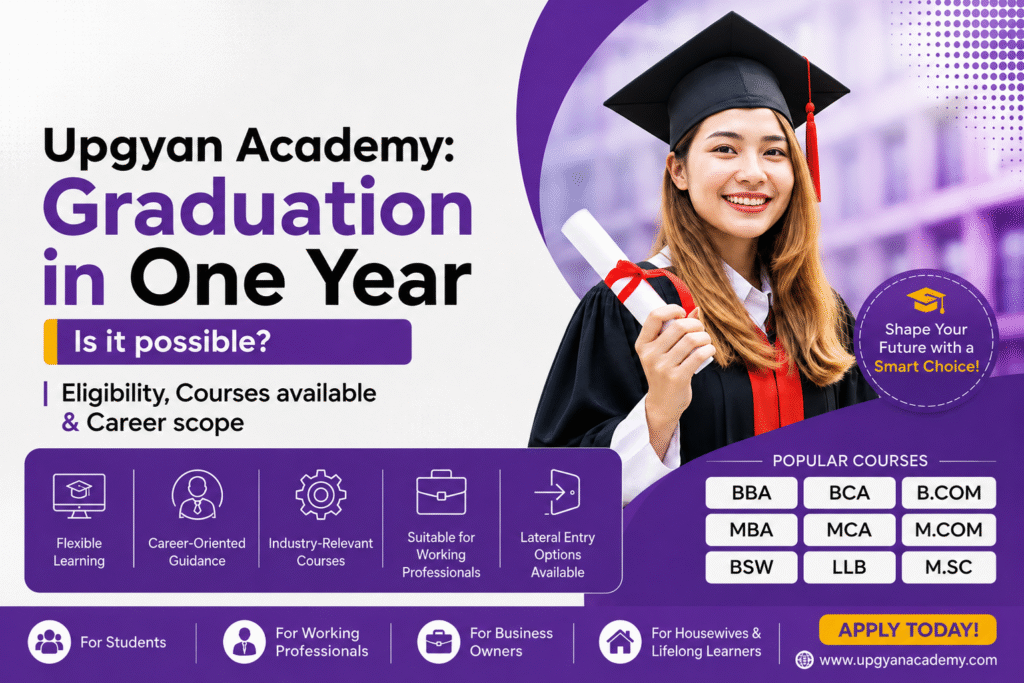
For students, college dropouts, working professionals, business owners, and homemakers, completing a graduation degree can sometimes feel difficult because of time, work, family responsibilities, or an education gap. Upgyan Academy helps learners explore flexible higher-education pathways, including options related to graduation in one year. However, before choosing any such program, it is important to understand what “graduation in one year” actually means, who may be eligible, which courses may be available, and how to verify the university and program. The exact duration and eligibility depend on the applicable university, course, previous academic record, credits, mode of education, and academic regulations.
The search for “graduation in one year” has become increasingly relevant for people who want to continue their education without putting their career, business, or family responsibilities on hold. But choosing a degree only because it appears faster can create problems if the student does not verify the awarding university, program recognition, eligibility, and academic requirements. This guide provides a practical explanation of graduation in one year, eligibility, available courses, admission, recognition, and career scope so that you can make a more informed decision.
Graduation in One Year – Is It Really Possible?
Graduation in one year may be possible only through specific academic pathways permitted by the relevant university and applicable regulations; it should not be assumed that every student can complete a conventional bachelor’s degree in one year. Previous academic credits, degree-completion provisions, university rules, and the specific program can influence the available route.
This distinction is extremely important.
A conventional undergraduate degree generally has a defined academic duration and curriculum. A student cannot simply shorten that duration independently. If a program is advertised as a one-year graduation course, the student should understand the academic mechanism behind the shorter timeline.
For example, a student may already have completed part of a bachelor’s program at another institution. Depending on applicable university policies, previous academic work or credits may potentially be considered.
Another learner may be starting undergraduate education after Class 12. Their situation can be completely different.
Therefore, “graduation in one year” can refer to different circumstances, including:
- Degree completion
- Credit transfer
- Recognition of previous academic credits
- Advanced entry where permitted
- University-approved accelerated pathways
- Flexible education
- Distance education
- Online education
- Other institution-specific academic arrangements
These options should not be treated as interchangeable.
Why Verification Matters
Suppose an advertisement says:
“Complete graduation in one year.”
The next question should be:
“Under which university-approved academic pathway?”
Students should also ask:
- Which university awards the degree?
- What is the official course name?
- What is the official duration?
- What previous qualifications are required?
- Can previous credits be considered?
- What examinations are required?
- Is the specific program available in the stated mode?
- What recognition applies to the specific program and academic session?
These questions can help distinguish a legitimate academic pathway from a vague marketing claim.
What Does “Graduation in One Year” Actually Mean?
The phrase “one year graduation” is commonly used by students searching for a faster or more flexible way to obtain an undergraduate qualification.
However, the phrase itself does not explain the academic structure.
A one-year graduation search may involve someone who:
- Has already studied at college.
- Has discontinued a bachelor’s degree.
- Has accumulated previous academic credits.
- Wants to restart education after a gap.
- Needs a flexible mode of study.
- Wants to study while working.
- Wants to continue education while managing a business or family.
Degree Completion
A learner who has already completed substantial academic study may explore whether the applicable institution has a degree-completion or credit-recognition mechanism.
This is different from starting an entirely new bachelor’s degree and completing its complete curriculum in one year.
Credit Transfer
Credit transfer refers broadly to the consideration of previously completed academic work under applicable institutional rules.
Whether credits can be transferred depends on factors such as:
- Previous institution
- Course
- Subjects completed
- Credits earned
- Academic records
- University policies
- Program requirements
Students should never assume that previous credits will automatically be accepted.
Flexible Education
Flexible education can be useful for learners who cannot follow a traditional classroom schedule.
Depending on the program, flexible learning may involve online or distance modes, but the recognition and availability of a particular program must be checked separately.
Online vs Distance Education
Online education and distance education are not simply marketing labels. They can have different regulatory and academic requirements.
Students should verify the specific university, program, mode, and academic session rather than assuming that all online or distance degrees have identical conditions.
Who May Consider a Flexible Graduation Pathway?
A flexible graduation option may be relevant to different types of learners.
Students
Students who have completed Class 12 and are looking for undergraduate education may explore different modes and programs according to their eligibility.
A student may prefer flexible education because they want to:
- Prepare for competitive examinations
- Complete an internship
- Work part-time
- Learn professional skills
- Manage another course
- Continue education from home
However, students should understand that flexible education does not mean fewer academic standards. The learner still needs to satisfy the requirements of the university and program.
College Dropout Students
College dropouts are among the learners who frequently search for graduation in one year.
A student may have left college because of:
- Financial difficulties
- Employment
- Family responsibilities
- Relocation
- Personal circumstances
- Lack of flexibility
If you are a dropout, do not immediately assume that you have to start from the beginning—or that you automatically qualify for a one-year degree.
Instead, collect your previous academic records.
These may include:
- Semester marksheets
- College leaving documents
- Transfer documents
- Previous enrollment information
- Credit information where available
The relevant institution can then determine whether your previous academic work can be considered under its applicable policies.
Example
Imagine Rahul completed Class 12 and enrolled in a bachelor’s program. He successfully completed several semesters but had to discontinue college after receiving a full-time job.
Five years later, he wants to complete graduation.
Rather than choosing an online advertisement promising an instant degree, Rahul should first provide his previous marksheets and academic records to the relevant institution.
The institution can then explain whether any previous study or credits can be considered and what academic requirements remain.
That is a much safer approach than assuming that every “one-year degree” advertisement applies to him.
Working Professionals
Working professionals often face a simple problem:
They want to study, but they cannot leave their jobs.
A conventional classroom schedule may conflict with:
- Office hours
- Shift work
- Business travel
- Meetings
- Professional responsibilities
A flexible graduation pathway can therefore be attractive.
However, working professionals should consider more than flexibility.
Before admission, check:
- Program recognition
- University
- Course structure
- Study requirements
- Examination schedule
- Assignment requirements
- Total fees
- Future education plans
A degree should fit both your current lifestyle and long-term career objective.
Business Owners
Business owners may have limited availability for traditional education.
An entrepreneur may spend much of the day handling:
- Customers
- Employees
- Suppliers
- Finance
- Marketing
- Operations
- Business expansion
Flexible education can allow business owners to continue their academic journey while managing their business.
A business-related undergraduate program may also be relevant to someone interested in management, commerce, entrepreneurship, or administration.
However, the choice should be based on eligibility and the actual program—not simply the advertised duration.
Housewives
Many homemakers put their education on hold because of marriage, childcare, family responsibilities, or other circumstances.
Later, they may want to return to education.
Flexible learning can potentially make education more manageable because learners may have greater control over when they study.
A homemaker considering graduation should examine:
- Eligibility
- Course
- Study mode
- Examination requirements
- Program recognition
- Total time commitment
- Future career or education plans
Returning to education after a gap is possible in many circumstances, but the correct academic pathway depends on the learner’s background.
Students With Education Gaps
An education gap does not necessarily mean the end of an academic journey.
Someone may have completed Class 12 but delayed college for several years. Another learner may have started college and discontinued it.
The appropriate option depends on:
Previous qualification + previous academic record + course + university rules + applicable regulations.
That is why a proper eligibility assessment is important.
Eligibility for Graduation in One Year
There is no single universal eligibility rule for every program advertised as graduation in one year.
Eligibility may depend on several factors.
1. Class 12 Qualification
For undergraduate admission, the learner’s Class 12 or equivalent qualification is generally an important starting point.
However, Class 12 eligibility for undergraduate admission should not be confused with automatic eligibility to complete a bachelor’s degree in one year.
2. Previous College Education
If you have previously attended college, your academic history may be relevant.
Students should preserve all previous:
- Marksheets
- Semester results
- Certificates
- Enrollment records
- Transfer-related documents
These records can help the institution assess your academic background.
3. Existing Academic Credits
Previous credits may be relevant where the applicable university permits credit recognition or transfer.
The student should ask:
“How many of my previously completed credits are recognized?”
Also ask:
“What academic requirements remain?”
Do not accept a verbal statement without understanding the applicable university policy.
4. Course Requirements
Different bachelor’s programs can have different requirements.
For example, the eligibility and curriculum for a commerce-related program may differ from those of a management or arts program.
5. Mode of Education
Eligibility and recognition can also depend on whether the course is offered through:
- Regular education
- Distance education
- Online education
- Another approved mode
The specific program and mode should be verified.
6. Academic Session
Recognition and program availability should be checked for the relevant academic session.
A university’s general recognition does not necessarily answer every question about every program and every mode.
Can You Do Graduation in One Year After 12th?
Completing Class 12 does not automatically mean that a conventional bachelor’s degree can be completed in one year.
A Class 12 student must first determine:
- Which undergraduate programs they are eligible for
- Which universities offer those programs
- What the official duration is
- Whether flexible study is available
- What recognition applies
- What academic requirements must be completed
Students should be especially careful with advertisements that suggest that every Class 12 student can simply obtain a complete bachelor’s degree within one year.
If a shorter pathway is being offered, ask for a clear explanation of the academic structure and the university’s applicable rules.
What Courses Are Available?
Students searching for a one-year degree course may encounter several undergraduate categories.
Depending on the university and applicable academic pathway, these may include:
B.Com – Bachelor of Commerce
B.Com can be relevant for learners interested in:
- Accounting
- Commerce
- Finance
- Banking
- Taxation
- Business
- Entrepreneurship
It may be particularly relevant for people working in accounts, finance, administration, or business.
BBA – Bachelor of Business Administration
BBA generally focuses on areas associated with:
- Business management
- Marketing
- Human resources
- Sales
- Operations
- Entrepreneurship
It may be relevant to aspiring managers, entrepreneurs, and business professionals.
BA – Bachelor of Arts
BA programs can cover different disciplines depending on the university, including areas within humanities and social sciences.
Students should check the exact subjects and program structure offered by the institution.
Other Undergraduate Programs
Other bachelor’s programs may also be available depending on the institution.
However, do not assume that every B.Com, BBA, BA, or other bachelor’s program can automatically be completed in one year.
The course duration and pathway must be verified with the relevant university.
Admission Process for Graduation
Once you identify a suitable academic pathway, follow a structured admission process.
Step 1: Check Your Eligibility
Start with your current educational qualification.
If you are a dropout, also collect your previous college records.
Step 2: Review Previous Academic Records
If you have previously attended college, provide your marksheets and other relevant records.
This is particularly important if you are investigating credit transfer or degree completion.
Step 3: Select the Course
Choose a course that matches your future plans.
For example:
- Commerce/accounting → B.Com may be relevant
- Business/management → BBA may be relevant
- Humanities/social sciences → BA may be relevant
The course should be selected based on your interests, eligibility, and career objectives—not simply its advertised duration.
Step 4: Identify the Awarding University
This is one of the most important admission checks.
Ask:
“Which university will issue my final degree?”
The organisation providing counselling or admission assistance may not necessarily be the institution awarding the degree.
Always identify the actual awarding university.
Step 5: Verify Recognition
For Indian higher education, students should consult authoritative information from the relevant regulatory bodies.
Step 6: Understand the Duration
If an institution describes a program as a “graduation in one year”, ask why the duration differs from the conventional duration of the degree.
Ask for information about:
- Academic structure
- Previous credits
- Degree-completion provisions
- Remaining coursework
- Examinations
- University rules
Step 7: Submit Documents
Submit the required documents only through the appropriate admission process.
Keep copies of everything you submit.
Step 8: Complete Admission Requirements
After admission, understand:
- Course requirements
- Examinations
- Assignments
- Study material
- Academic calendar
- Support channels
- University communication
Flexible education still requires students to complete the academic requirements specified by the program.
Documents Required
The exact document checklist varies by university and program.
Commonly requested documents may include:
- Class 10 certificate
- Class 12 certificate
- Previous college marksheets
- Transfer certificate, where applicable
- Migration-related documents, where applicable
- Identity proof
- Passport-size photographs
- Previous degree/certificate, where applicable
- Other university-specific documents
For Dropout Students
Previous college marksheets can be especially important.
Do not throw away old academic records simply because you left college years ago.
Those documents may help establish your previous academic history.
Graduation in One Year Fees
There is no single fee applicable to every graduation in one year program.
The total cost can depend on:
- University
- Course
- Mode of education
- Academic pathway
- Credit requirements
- Examination fees
- Study materials
- Administrative charges
- Other university-specific fees
Because fees can change by program and academic session, students should verify the current fee structure before admission.
Do not rely solely on a social media advertisement or verbal fee quote.
Questions to Ask About Fees
Before making a payment, ask:
- What is the complete course fee?
- Are examination fees included?
- Are study materials included?
- Are there additional university charges?
- What payment method should be used?
- Who is receiving the payment?
- Will an official receipt be provided?
- What is the refund policy?
Keep your payment receipts and admission documents safely.
Career Scope After Graduation
A bachelor’s degree can provide an academic foundation for employment, professional development, entrepreneurship, or further education.
However, a degree does not automatically guarantee a job, salary, promotion, or career success.
Career opportunities depend on several factors, including:
- Degree
- Skills
- Experience
- Industry
- Employer
- Job role
- Communication skills
- Technical knowledge
- Additional qualifications
Potential Career Areas
Depending on the degree and skills, graduates may explore areas such as:
Private-Sector Employment
Graduates may apply for roles where an undergraduate qualification is part of the employer’s eligibility criteria.
Administration
Graduation can be relevant to certain administrative and office-based roles.
Sales and Business Development
Graduates with communication and business skills may explore sales-related opportunities.
Finance and Accounts
A commerce-related background may be relevant to accounting and finance support roles, subject to employer requirements and additional skills.
Business Operations
Graduates can explore roles involving coordination, operations, customer management, and business support.
Entrepreneurship
A degree can complement practical business experience, although entrepreneurial success depends on many factors beyond academic qualifications.
Higher Education
Graduation can also serve as the foundation for further study, subject to the eligibility requirements of the next institution.
Can Graduation Help With Higher Education?
Yes, a bachelor’s qualification can potentially provide a pathway toward postgraduate education, but admission requirements differ between institutions and programs.
Depending on eligibility, learners may explore programs such as:
- MBA
- M.Com
- MA
- Other master’s programs
- Professional qualifications
For example, someone interested in an MBA should check the admission criteria of the particular university or business school they want to attend.
Do not assume that every bachelor’s qualification automatically qualifies a student for every postgraduate program.
Graduation in One Year for Dropout Students
For dropout students, the most important step is to understand what they have already completed.
Consider this situation:
A student completed Class 12 and enrolled in a bachelor’s program. After two years, they left college to start working. Five years later, they want to complete graduation.
The student should:
- Collect all previous marksheets.
- Identify the university and program previously studied.
- Determine whether previous academic credits exist.
- Ask whether those credits can be considered.
- Identify available completion pathways.
- Verify the new awarding university.
- Confirm the official duration.
- Check recognition and future eligibility.
This approach is better than assuming that a student automatically qualifies for a one-year degree.
Avoid Fake Degree Providers
Dropout students can sometimes be vulnerable to advertisements promising extremely fast degrees.
Be cautious of providers claiming:
- Guaranteed degrees
- No examinations
- No academic requirements
- Guaranteed government jobs
- Guaranteed promotions
- “Recognition does not matter”
- Instant certificates
Always verify the underlying university and academic pathway.
Graduation in One Year for Working Professionals
For working professionals, the biggest advantage of flexible education can be the ability to manage study alongside employment.
A professional should create a realistic study schedule around:
- Office hours
- Travel
- Family responsibilities
- Assignments
- Examinations
- Revision
Benefits to Consider
A graduation qualification may help a professional:
- Meet educational eligibility requirements
- Prepare for higher education
- Build academic credentials
- Develop knowledge relevant to their field
- Explore new career opportunities
But the qualification should be selected carefully.
If your long-term goal is an MBA, for example, check whether the undergraduate qualification you are considering will meet the MBA institution’s admission criteria.
Graduation for Business Owners and Housewives
Business Owners
Business owners may prefer flexible study because their schedules can change frequently.
An undergraduate qualification can also provide structured knowledge in areas such as:
- Business
- Accounting
- Management
- Marketing
- Operations
However, practical business experience remains important.
Housewives
For homemakers, flexible education may provide an opportunity to restart an academic journey around family responsibilities.
A learner may have an education gap of several years, but that does not mean they should stop exploring legitimate academic opportunities.
The focus should be on:
Eligibility + recognition + course suitability + academic requirements.
How to Verify Whether a Graduation Program Is Legitimate
This is arguably the most important part of researching a one-year degree course.
Step 1: Identify the Awarding University
Find out who will issue your final degree.
Step 2: Visit the University’s Official Website
Search for the exact course and admission information.
Compare it with information provided by the admission counsellor.
Step 3: Check UGC Information
Use the official UGC website:
Do not rely exclusively on third-party advertisements for recognition-related claims.
Step 4: Check UGC-DEB Information
For applicable online or distance programs, consult:
Check information relevant to the specific program, mode, and academic session.
Step 5: Verify the Specific Program
A university’s general status is not enough.
Ask:
Is this particular program offered through this particular mode for the relevant academic session?
Step 6: Verify the Mode of Education
Understand whether the program is:
- Regular
- Online
- Distance
- Another approved mode
Step 7: Verify the Academic Session
Rules and program availability can change.
Therefore, check current information rather than relying on an old advertisement or outdated
document.
Step 8: Read Admission Documents
Review:
- Program duration
- Eligibility
- Fees
- Examination requirements
- Course structure
- Mode
- University name
Step 9: Ask for Written Clarification
If someone says you can complete graduation in one year, ask them to explain the academic pathway in writing.
Step 10: Keep All Records
Save:
- Application form
- Admission confirmation
- Fee receipts
- University communication
- Academic documents
- Course information
This creates a clear record of your admission.
Key Factors to Consider Before Admission
Be cautious if a provider makes claims such as:
“Guaranteed Degree”
No student should assume that a degree is guaranteed without completing applicable academic requirements.
“Guaranteed Job”
A degree provider cannot automatically guarantee employment.
“Guaranteed Promotion”
Career progression depends on employers and individual performance.
“No Eligibility Required”
Legitimate academic programs generally have defined admission requirements.
“No University Name”
The awarding university should be clearly identifiable.
“No Examination”
Do not assume that a degree can be obtained without meeting the academic requirements of the program.
“Pay Immediately”
Pressure to make an immediate payment without documentation is a warning sign.
“Recognition Doesn’t Matter”
Recognition and academic legitimacy should be taken seriously.
Before choosing a program, ask yourself:
- Have I completed Class 12?
- Have I previously attended college?
- Do I have previous academic credits?
- Am I currently working?
- Do I need flexible education?
- What career do I want to pursue?
- Do I need graduation for higher education?
- Have I identified the awarding university?
- Have I checked applicable recognition?
- Have I confirmed the exact duration?
If you can answer these questions clearly, you will be in a much better position to evaluate your options.
Graduation in One Year: Quick Overview
| Factor | What to Check |
| Eligibility | Previous qualification and academic records |
| Duration | Official university-approved pathway |
| Recognition | Applicable regulatory recognition |
| Course | Program-specific availability |
| Fees | Current official fee structure |
| Admission | University requirements |
| Documents | Academic and identity records |
| Career | Depends on degree, skills and experience |
Frequently Asked Questions About Graduation in One Year
1. Is graduation in one year possible?
It can be possible only through specific academic pathways permitted by the relevant university and applicable regulations. Students should not assume that every conventional bachelor’s degree can automatically be completed in one year. Previous academic credits, transfer provisions, degree-completion arrangements, and program-specific rules may influence the available pathway.
2. Can I complete graduation in one year after 12th?
Class 12 completion alone does not automatically mean that a standard bachelor’s degree can be completed in one year. Students should check the university, course, eligibility, official duration, academic pathway, and applicable regulations before enrolling in any program advertised as a one-year graduation option.
3. Is a one-year degree valid?
Its validity depends on the specific university, program, mode of education, academic pathway, and applicable regulations. Students should verify the exact qualification through authoritative sources and the awarding university instead of judging validity solely from the phrase “one-year degree.”
4. Who is eligible for graduation in one year?
Eligibility depends on the specific academic pathway. Factors may include Class 12 qualification, previous college education, existing credits, previous marksheets, course requirements, university rules, mode of education, and the relevant academic session.
5. Can a college dropout complete graduation?
A college dropout can explore options to continue higher education. Previous academic records may be important, particularly if the learner has completed semesters or earned credits. Whether those credits can be recognized depends on the applicable university policy and academic pathway.
6. Can working professionals pursue graduation?
Yes, working professionals can explore flexible graduation options where they meet the program’s eligibility requirements. Online or distance learning may offer flexibility, but students should verify the specific university, program, mode, recognition, examination requirements, and academic session before admission.
7. Can housewives pursue graduation?
Yes, homemakers can explore suitable undergraduate education options if they meet the relevant eligibility criteria. Flexible learning can be useful for people managing family responsibilities, but the academic program, university, recognition, duration, and examination requirements should be verified before enrollment.
8. Can business owners pursue flexible graduation?
Business owners can explore flexible undergraduate programs that fit around their professional responsibilities. They should consider the course’s relevance to their career goals as well as recognition, academic requirements, examination schedules, fees, and future education plans.
9. Which courses are available?
Possible undergraduate categories include B.Com, BBA, BA, and other bachelor’s programs depending on the institution. However, the availability and duration of each course are university-specific. Students should not assume that every bachelor’s course can automatically be completed in one year.
10. How much does graduation in one year cost?
There is no universal fee. Costs can vary according to the university, course, study mode, academic pathway, examination requirements, study materials, and administrative charges. Students should request the current and complete fee structure before making a payment.
11. What documents are required?
Common documents may include Class 10 and Class 12 certificates, previous college marksheets, identity proof, photographs, and transfer or migration documents where applicable. The exact requirements depend on the university and program.
12. Is distance graduation recognized?
Distance education can be recognized when the relevant university, program, mode, and academic session meet applicable requirements. Students should check current information through authoritative sources, including the UGC and UGC-DEB where applicable.
13. Can I pursue an MBA after graduation?
A bachelor’s qualification can potentially provide a route to MBA admission, but eligibility depends on the MBA institution and program. Students should check the specific admission requirements of the university or business school they plan to attend.
14. Can I pursue postgraduate education after a flexible graduation pathway?
Potentially, but postgraduate admission is institution-specific. Before choosing a graduation pathway, students who plan to pursue further education should check whether their intended postgraduate institution accepts the particular undergraduate qualification.
15. How do I verify a university?
Start with the university’s official website and relevant official regulatory information. For online or distance education, also check applicable UGC-DEB information for the specific program, mode, and academic session.
16. What should I check before admission?
Check the awarding university, eligibility, official duration, program, mode of education, applicable recognition, fees, examinations, academic requirements, and future-study eligibility. Keep written admission documents and payment receipts.
Before You Enroll: Graduation Checklist
Before enrolling in any program marketed as graduation in one year, use this checklist:
- ☑ Identify the awarding university
- ☑ Check the university’s official information
- ☑ Verify applicable recognition
- ☑ Check the specific program
- ☑ Verify the mode of education
- ☑ Confirm the academic session
- ☑ Confirm your eligibility
- ☑ Confirm the official duration
- ☑ Understand credit requirements
- ☑ Check complete fees
- ☑ Review examination requirements
- ☑ Keep written admission records
- ☑ Check future higher-education eligibility
How UPGYAN Academy Can Help
Choosing a graduation pathway can be confusing, particularly if you are a college dropout, working professional, business owner, homemaker, or learner returning to education after a gap.
UPGYAN Academy can be a starting point for learners who want to explore flexible education options, understand course possibilities, review admission considerations, and identify the factors they should verify before enrollment.
However, students should make their final decision only after understanding the awarding university, specific program, applicable recognition, eligibility, duration, fees, examination requirements, and future educational goals.
If you are considering graduation in one year, discuss your academic background and requirements with the appropriate education counsellor, collect your previous records, and independently verify the relevant university and program information.
Conclusion
The search for “graduation in one year” is understandable. Students may want to complete their education faster, college dropouts may want to restart their academic journey, working professionals may need a qualification without leaving their jobs, business owners may need flexibility, and homemakers may want to return to education after a gap.
But the most important question is not simply:
“Can I get graduation in one year?”
The better question is:
“Which academic pathway is appropriate for my qualification, and is it officially recognized and suitable for my future goals?”
A conventional bachelor’s degree should not automatically be assumed to become a one-year degree. In some circumstances, previous academic credits, transfer arrangements, degree-completion provisions, or other university-approved pathways may affect the duration. The exact answer depends on the university, course, student’s academic background, applicable regulations, and mode of education.
For dropout students, previous marksheets and academic records can be particularly important. For working professionals, flexibility and examination schedules may matter. For business owners and homemakers, the ability to balance education with existing responsibilities can be a major consideration.
Before admission, always verify:
Eligibility → University → Program → Recognition → Mode → Duration → Fees → Examination Requirements → Future Education
UPGYAN Academy can help learners explore flexible education pathways and understand the admission process. At the same time, students should independently verify official university and regulatory information before making an enrollment decision.
A shorter academic pathway should never be judged only by how quickly it promises a qualification. The better choice is the pathway that is appropriate, properly documented, academically legitimate, and aligned with your long-term education and career goals.
UpGyan Academy – Graduation In One Year | One Year Degree Course | Direct Admission In B.tech | MBA Degree In One Year
Address : Level 2, Dewan Centre, 69, Swami Vivekanand Rd, next to Persia Darbar, Momin Nagar, Jogeshwari West, Mumbai, Maharashtra 400102, India
Phone number : +91 9867864152
Get direction : https://maps.app.goo.gl/jaenc6XpLxEhGKnw9
Website : https://upgyanacademy.com/